Walk into almost every procurement discussion in the UAE at present, and ISO certification will be mentioned within a couple of minutes. What was once an option for larger companies has now become a base requirement for all construction, healthcare, logistics, food production, and technology. The pace at which local firms are going after certification has increased significantly over the last couple of years.Government Contracts are the main driver of the Demand
A large share of the current push stems directly from semi-government or government tendering requirements. Many public sector contracts across the Emirates contain a pertinent ISO certificate as a requirement prequalification requirement rather than as an optional requirement, which implies that firms without one are effectively excluded from bids before price or ability even get into the mix.
International Trade Partners Expect It as a Norm
The UAE's position as an interregional trade and logistics hub means that a significant portion of local businesses work with foreign partners. And those partners increasingly treat ISO certification as a key credibility signal, not a distinct feature. An European or North American buyer evaluating a provider based in the United Arab Emirates will usually choose based partly on whether an acknowledged management system certificate is in place. it provides them with a reliable benchmark regardless of how well they know about the local market.
Free Zones Are Actively Encouraging certification
A few of the biggest UAE free zones are now promoting the benefits of certification in the business planning packages they offer, recognising that certified tenants are more likely to draw in better customers and expand more successfully. This encouragement by the institution, paired by real pressure from competition, has transformed certification from as a niche consideration into something more akin to standard business practices.
In the world of risk and insurance, Risk Considerations and Insurance are Playing a Growing Role
Insurers who operate in the UAE Market are increasingly including management system certification into their risk evaluations, particularly for areas such as manufacturing and construction, where the failure to maintain safety and quality have a large risk of liability. A certification of a quality or safety management system gives insurers an established basis for risk pricing. Some are now offering more favorable conditions to applicants who have been certified as a result.
The Cost of Certifications Has Regressed
The increasing competition among certification agencies and consultants operating in the UAE has reduced prices dramatically compared to 10 years earlier, making certification available for smaller and mid-sized businesses that previously assumed it was only available to larger corporations. The decrease in costs has opened the doors to a wider array of firms seeking certification first time.
Different Standards Suit Different Businesses
Every business does not require the same certification and figuring out which one really applies is the most difficult thing to figure out. A construction firm's objectives around safety management differ from the priorities of a software business with regards to security and information. This is the reason demand has increased in a variety of different standards rather that focusing on just one.
What does this mean for businesses? Still in the dark
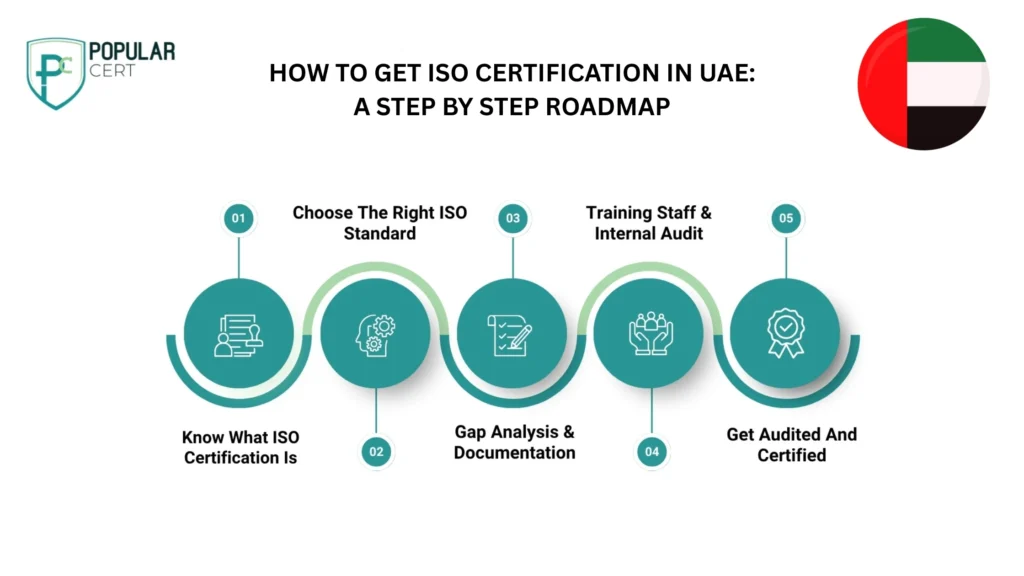
For those who are still debating the merits of certification what is actually happening in 2026 is that it shifts from whether competition have it to how many tender opportunities are being missed with certification. The process typically starts by assessing the gap against the relevant standard, followed by a planned timeline for implementation before an external audit, and the entire process is a lot easier to follow than even five years ago.
The Talent Market Doesn't Have the Right Response
In the past few years, certification has become vital to the way UAE businesses conduct their business, an actual local talent market has developed around quality security, and environmental management roles, with far more professionals possessing lead auditors who are recognized and credentials for implementation than at any point previously. This has made it more simple for businesses to find internal employees capable of sustaining a a management system long beyond the time that their initial accreditation program concludes, as opposed to being dependent entirely on external experts for the duration of time.
Multinational Companies Set the Regional Tone
Many multinationals that have local or Middle East headquarters out of the UAE have global certification requirements with them expecting local suppliers as well partners to follow the same standards. This has had a significant ripple effect as local businesses that are supplying to these multinational supply chains often experience certification requirements that cascade down from client expectations that originated very far from the UAE in the UAE itself.
The increasing importance of certification is seen as a Growth Enabler, More than Compliance
Perhaps the most significant change in the last couple of years is that more UAE enterprises now consider certification as something that encourages growth, through opening new opportunities for tenders and international partnerships, instead of using it as an expensive compliance expense. This reframes the investment much easier to justify internally because it connects directly to revenue opportunity instead of being placed in the budget for compliance.
What will we be expecting in the years ahead
In light of the current situation, it seems reasonable to assume that ISO certification will keep moving away from a competitive edge to a full market entry requirement across an increasing range of UAE sectors in the coming years. Businesses that get ahead of this shift now instead of holding off until certification becomes mandatory, generally find the process less stressful, with the resultant strong competitive position.
How long does the entire process will typically take?
The full journey beginning with the gap assessment and ending with the certificate issuing process typically takes from 3 to 9 months, contingent on the size and complexity of the business and maturity of the process, and how quickly internal teams can be able to implement required modifications. Business under intense pressure often try to reduce this time frame, but over-rushing the implementation phase tends to result in a management system that has difficulty in the initial surveillance audit, which makes a reasonable timeframe an investment worth it.
In the end, the soaring demand for ISO certification in the UAE represents a market that has grown up beyond focusing on safety and quality as a mere internal decision-making process and is now treating it as an essential requirement to conduct business with seriousness, both locally as well as internationally. For any company that is ready to start, the first practical step is to have a brief, honest discussion with an accredited certification organization or a trusted consultant about which quality standard corresponds to current operational needs and expectations, not merely guessing by looking at what competitors appears to have on their site. This momentum doesn't show any signs of slowing so the current moment a genuinely sensible time to consider certification to move from consideration to an action. Follow the best ISO 27001 Certification for website advice.

ISO 14001 Certification Why Iso 14001 Certification? Environmental Management Is Important For Uae Companies
Environmental issues have moved from a peripheral concern to an essential business concern across the UAE in part due to national sustainability commitments and partly due to the increasing demands of clients and regulatory expectations. ISO 14001, the international standard for environmental management systems is now a standard for companies who want to display genuine, well-constructed environmental responsibility rather than good desires alone.What ISO 14001 Actually Requires
The standard demands that businesses be aware of the environmental aspects of their operation, be aware of the consequences these aspects bring and set up systems in place to manage as well as reduce negative effects in the course of time. This could include anything including reducing emissions and waste in manufacturing settings to cutting down on paper and energy usage in a service-oriented office business, as this standard applies to the extent to which a company's environmental footprint appears to be.
Alignment with UAE's National Sustainability Goals
The UAE's broader national commitments on sustainability and net zero goals have created real momentum for environmental management. ISO 14001 certification gives individual businesses an opportunity to demonstrate their compliance with those larger goals. It is more important to align with firms bidding for government or semi-government contracts, as environmental qualifications are now an precise evaluation criterion.
Industries - Where it's important
Manufacturing, construction, oil and gas, and logistics face the greatest environmental scrutiny given the size of their operations, but service-based companies are increasingly looking to obtain certification as well, both for tender eligibility as well as real cost savings as a result of the use of resources more efficiently. Even companies with relatively light environmental footprint often find the systematic approach uncovers surprising efficiency benefits.
The Legal Compliance Angle
A large portion in ISO 14001 involves identifying and checking compliance with relevant environmental legislation and rules and regulations. These requirements in the UAE environment spans federal environmental law as well as specific regulations for the emirates. Certified companies typically have a more precise, up-to-date understanding of their regulatory obligations than those who aren't certified, making it less likely for accidental infractions and penalties.
Integration with Other Management Systems
Many UAE companies that want to pursue ISO 14001 already hold or are simultaneously pursuing ISO 9001, and the two standards have sufficient structural similarities that an integrated management program covering both can be more efficient that treating them as entirely distinct projects. This approach cuts down on duplicate documentation and audit effort considerably for businesses that are managing multiple certifications.
What is the Certification Process Is Like
As with all management system standards certification follows a well-defined plan: a preliminary gap assessment, implementing necessary processes and documentation, internally audited, afterwards, a two-stage external inspection that is conducted by a certified certification body. Continuous surveillance audits, which are typically annually, assure that the management system remains properly maintained instead of reversing the process after the initial certification is issued.
Truly Business Benefits That Go Beyond the Certificate
Beyond the eligibility for tenders and regulatory certainty, companies who have adopted ISO 14001 properly often uncover real cost savings by implementing better resource and waste control, as well as benefits for reputation from increasingly eco-conscious clients and their partners. These real-world benefits are an integral part of the reason why certification for environmental sustainability has gone beyond being merely a compliance-driven requirement for many UAE firms.
Assessing What Really Matters
Implementing a well-designed ISO 14001 system focuses measurement efforts on the environmental issues that matter the most for an individual business and not tracking measurements solely because they're simple to quantify. Logistics companies might focus on efficient routes and consumption of fuel in comparison to a manufacturing company, which may focus more on water usage and waste production depending on where each company's actual environmental impact lies.
Securing Contractors and Suppliers
Many UAE businesses have discovered that a large portion of their environmental footprint comes from contractors and suppliers rather than directly with their own operations, and ISO 14001 encourages businesses to look at the wider supply chain impact rather than making environmental management purely an internal issue. This has led certain certified UAE businesses to start asking their own key suppliers about their environmental practices, resulting in an ensuing ripple effect in the local supply chain.
The Emergency Preparedness Plan is a part of the Standard
ISO 14001 requires businesses to consider the possibility of environmental emergency situations pertinent to their activities, such as chemical leaks or equipment malfunctions that could have environmental consequences as well as have real-time procedures for responding instead of addressing such events reactively. This element of preparedness often exposes weaknesses that companies had not previously looked at, specifically in regards to staff training for emergencies.
A Standard That Rewards Genuine Engagement
Ultimately, ISO 14001 rewards businesses who treat environmental management as an ongoing priority rather than as a formality that is completed only once and then forgotten. UAE businesses that incorporate the standards' principles into their daily process of decision-making, and not merely putting the standard within a separate compliance process, tend to enjoy the most substantial environmental and branding benefits as time passes.
Water Management Needs Special Attention in the UAE Setting
The UAE's climate is extremely dry as well as its dependence on desalinated aquifers Water use and management typically requires a special focus within the ISO 14001 system compared with areas where water scarcity is not as pressing. Companies that incorporate water efficiency into their environmental management process in the beginning will have this among the top practical aspects of certification in the local environment.
For UAE enterprises that meet ISO 14001, the certification will be a direct response to real market and regulatory pressure and an opportunity to address environmental issues more deliberately, which increasingly is of interest to regulators, clients as well as the UAE's own national sustainability objectives. As the expectations for environmental sustainability across the UAE increase firms that implement a true environmental management capabilities today, instead of waiting until it becomes an unavoidable requirement, will succeed for the future. The process should not seem overwhelming for small-sized businesses since the usual scales roughly, and even modest, genuine environmental improvements implemented consistently will be a boon to auditors much more than a lofty plan that never gets properly followed through. In the end, consistency, not an individual's ambition, is the only thing that auditors and real green outcomes can be rewarded with. Small, steady changes tend outperform ambitious strategies that slow down after the first few months. Take a look at the top ISO 27001 Certification for website advice.